Introduction
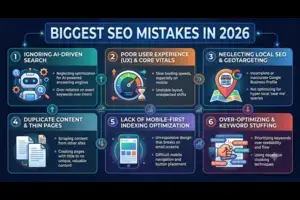
In 2026, search engine optimization (SEO) has become more sophisticated than ever before. Search engines are no longer focused solely on keywords and backlinks; they now prioritize user experience, content quality, expertise, trustworthiness, and relevance. While businesses continue investing heavily in digital marketing, many still make critical SEO mistakes that limit their online visibility, reduce website traffic, and negatively impact conversions.
The SEO landscape is constantly evolving, driven by advancements in artificial intelligence, changing user behavior, voice search, mobile-first experiences, and increasingly intelligent search algorithms. Businesses that fail to adapt risk losing valuable opportunities to competitors who understand and implement modern SEO best practices.
This article explores the biggest SEO mistakes businesses make in 2026 and provides actionable insights to help organizations improve their search rankings and achieve sustainable growth.
1. Prioritizing Search Engines Over Users
One of the most common SEO mistakes businesses make is creating content solely for search engines instead of real people. While optimization remains important, modern search algorithms are designed to reward websites that provide genuine value to users.
Many businesses still publish articles packed with keywords but lacking meaningful information. This approach often results in poor engagement metrics, including high bounce rates and low time-on-page.
Instead, businesses should focus on:
-
Solving user problems
-
Answering common questions
-
Providing actionable insights
-
Creating engaging experiences
-
Delivering comprehensive information
When content is written for people first, search engines naturally recognize its value.
2. Publishing Low-Quality AI-Generated Content
Artificial intelligence has transformed content creation, making it easier than ever to produce articles quickly. However, many businesses make the mistake of publishing AI-generated content without human review or enhancement.
Search engines have become highly effective at identifying content that lacks originality, expertise, and depth. Generic articles often fail to rank because they do not provide unique value.
To avoid this mistake:
-
Use AI as a writing assistant, not a replacement
-
Add expert insights and personal experiences
-
Include original research and examples
-
Fact-check all information
-
Improve readability and engagement
Businesses that combine AI efficiency with human expertise are more likely to succeed in search rankings.
3. Ignoring Search Intent
Search intent refers to the reason behind a user's search query. In 2026, understanding intent is more important than targeting keywords alone.
Many businesses create content around keywords without considering what users actually want. As a result, their pages fail to satisfy searchers and struggle to rank.
There are four primary types of search intent:
Informational Intent
Users seek information or answers.
Navigational Intent
Users want to find a specific website or brand.
Commercial Intent
Users are researching products or services before making a purchase.
Transactional Intent
Users are ready to buy or take action.
Successful SEO strategies align content with the appropriate search intent, improving user satisfaction and search visibility.
4. Neglecting Technical SEO
Technical SEO remains a foundational component of search engine optimization. Many businesses focus exclusively on content while overlooking technical issues that hinder website performance.
Common technical SEO mistakes include:
-
Slow page loading speeds
-
Broken links
-
Duplicate content
-
Improper redirects
-
Missing XML sitemaps
-
Crawlability issues
-
Indexing errors
Search engines prioritize websites that provide smooth, accessible experiences. Regular technical audits help identify and resolve these issues before they impact rankings.
5. Poor Mobile Optimization
Mobile devices continue to dominate internet usage in 2026. Despite this trend, many businesses still offer subpar mobile experiences.
Common mobile optimization issues include:
-
Slow mobile loading times
-
Difficult navigation
-
Unresponsive design
-
Small fonts
-
Intrusive pop-ups
Search engines use mobile-first indexing, meaning the mobile version of a website plays a significant role in determining rankings.
Businesses must ensure their websites perform flawlessly across smartphones and tablets to remain competitive.
6. Failing to Build Topical Authority
Publishing isolated articles without a clear content strategy is another major SEO mistake.
Search engines increasingly reward websites that demonstrate expertise across entire topics rather than individual keywords.
For example, a digital marketing company should create comprehensive content covering:
-
SEO
-
Social media marketing
-
PPC advertising
-
Email marketing
-
Content marketing
-
Analytics
-
Marketing automation
By building topic clusters and interconnected content, businesses establish authority and improve rankings across multiple related searches.
7. Ignoring User Experience Signals
User experience plays a critical role in modern SEO. Search engines evaluate how users interact with websites and use these signals to assess quality.
Poor user experience can include:
-
Cluttered layouts
-
Excessive advertisements
-
Difficult navigation
-
Confusing design
-
Slow loading pages
A positive user experience encourages visitors to stay longer, explore additional pages, and engage with content.
Businesses that prioritize usability often see improvements in both rankings and conversions.
8. Overlooking Local SEO Opportunities
Many businesses depend on local customers but fail to optimize their online presence for local searches.
Local SEO mistakes include:
-
Incomplete business profiles
-
Inconsistent contact information
-
Lack of customer reviews
-
Missing local keywords
-
Poor location-based content
Local search visibility can significantly impact customer acquisition, especially for service-based businesses.
Optimizing local listings, encouraging reviews, and maintaining accurate business information are essential practices.
9. Focusing on Quantity Instead of Quality
Some businesses believe publishing large amounts of content automatically improves SEO performance.
However, search engines prioritize quality over quantity.
Publishing dozens of weak articles often produces fewer results than creating a handful of comprehensive, high-quality resources.
Effective content should be:
-
Accurate
-
Detailed
-
Relevant
-
Well-structured
-
Engaging
-
Original
Quality content generates more backlinks, social shares, and user engagement, contributing to long-term SEO success.
10. Neglecting Content Updates
Many businesses publish content and never revisit it.
Outdated information can negatively impact credibility and rankings, especially in industries that change rapidly.
Regular content updates help:
-
Maintain accuracy
-
Improve relevance
-
Address new trends
-
Enhance user experience
-
Increase search visibility
Refreshing existing content is often more effective than constantly creating new articles.
11. Weak Internal Linking Strategy
Internal links help search engines understand website structure and content relationships.
Unfortunately, many businesses overlook internal linking opportunities.
Benefits of internal linking include:
-
Improved crawlability
-
Better user navigation
-
Increased page authority distribution
-
Higher engagement rates
Every website should implement a strategic internal linking framework that connects related content and guides users through their journey.
12. Chasing Every SEO Trend
SEO evolves rapidly, but constantly chasing every new trend can be counterproductive.
Many businesses abandon effective strategies whenever a new tactic emerges.
Instead, organizations should focus on proven fundamentals:
-
High-quality content
-
Technical excellence
-
User experience
-
Authority building
-
Trust and credibility
Adapting to changes is important, but long-term success requires consistency and strategic thinking.
13. Ignoring E-E-A-T Principles
Search engines increasingly evaluate content based on Experience, Expertise, Authoritativeness, and Trustworthiness (E-E-A-T).
Businesses that fail to demonstrate credibility often struggle to compete.
Ways to strengthen E-E-A-T include:
-
Showcasing author credentials
-
Publishing expert insights
-
Including case studies
-
Displaying customer testimonials
-
Maintaining transparency
Building trust with users and search engines remains essential for sustainable SEO performance.
14. Poor Backlink Practices
Backlinks continue to influence search rankings, but outdated link-building methods can cause serious problems.
Common mistakes include:
-
Buying low-quality links
-
Participating in link schemes
-
Using irrelevant backlinks
-
Prioritizing quantity over quality
Businesses should focus on earning links naturally through valuable content, partnerships, industry relationships, and thought leadership.
Quality backlinks from authoritative sources provide far greater value than large numbers of low-quality links.
15. Not Tracking SEO Performance
Many organizations invest in SEO without measuring results effectively.
Without proper tracking, businesses cannot identify what's working or where improvements are needed.
Important SEO metrics include:
-
Organic traffic
-
Keyword rankings
-
Click-through rates
-
Bounce rates
-
Conversion rates
-
Backlink growth
-
Page speed
Regular analysis enables data-driven decision-making and continuous optimization.
16. Ignoring Voice Search Optimization
Voice search continues to grow as users rely on smart devices and virtual assistants.
Voice searches are typically:
-
Longer
-
More conversational
-
Question-based
Businesses that ignore voice optimization may miss valuable traffic opportunities.
Strategies include:
-
Targeting conversational keywords
-
Answering common questions
-
Creating FAQ pages
-
Optimizing local content
Voice-friendly content improves visibility across multiple search channels.
17. Forgetting About Conversion Optimization
Traffic alone does not guarantee business success.
Some companies focus entirely on rankings while neglecting conversion optimization.
A website should guide visitors toward meaningful actions such as:
-
Contact form submissions
-
Purchases
-
Newsletter signups
-
Consultation bookings
Combining SEO with conversion optimization maximizes the return on digital marketing investments.
18. Failing to Create a Long-Term SEO Strategy
SEO is not a one-time project.
Many businesses expect immediate results and abandon efforts when rankings do not improve quickly.
Successful SEO requires:
-
Consistent content creation
-
Ongoing optimization
-
Regular audits
-
Continuous learning
-
Long-term commitment
Organizations that view SEO as a long-term investment typically achieve more sustainable growth.
The Future of SEO in 2026 and Beyond
As search engines become more intelligent, SEO is shifting from traditional optimization tactics toward user-centric experiences. Businesses that focus on delivering value, building trust, and creating exceptional content will continue to thrive.
Artificial intelligence, voice search, personalized experiences, and evolving user expectations will shape the future of search. Companies that remain adaptable while maintaining strong SEO fundamentals will gain a significant competitive advantage.
Conclusion
The biggest SEO mistakes businesses make in 2026 are often not technical shortcuts or algorithm misunderstandings—they stem from losing sight of the user. From publishing low-quality AI content and ignoring search intent to neglecting technical SEO and user experience, these mistakes can significantly limit online growth.
The most successful businesses understand that SEO is no longer just about rankings. It is about creating valuable content, delivering outstanding user experiences, building trust, and meeting customer needs at every stage of their journey.
By avoiding these common mistakes and embracing a user-first approach, businesses can improve search visibility, attract qualified traffic, generate more leads, and achieve long-term digital success in an increasingly competitive online landscape.