Introduction
In today’s competitive digital world, small businesses face many challenges. Managing customers, tracking sales, improving communication, and staying organized can become difficult as a business grows. Many small business owners still use spreadsheets, notebooks, or manual methods to manage customer information, which often leads to confusion, missed opportunities, and poor customer experiences.
This is where CRM becomes highly valuable.
CRM, or Customer Relationship Management, is a powerful tool that helps small businesses organize customer data, improve communication, manage sales activities, and build stronger customer relationships. Modern CRM systems allow small businesses to work more efficiently and compete effectively in the digital marketplace.
At Cubetechworld, we believe CRM solutions are not only for large companies. Small businesses can benefit greatly from CRM by improving productivity, customer satisfaction, and long-term growth.
In this blog, we will explore the major benefits of CRM for small businesses, why CRM is becoming essential, and how it helps businesses grow smarter in today’s digital era.
What is CRM?
CRM stands for Customer Relationship Management.
It is software designed to help businesses manage:
- Customer information
- Sales activities
- Marketing campaigns
- Customer communication
- Support services
CRM stores all customer-related data in one centralized platform, making it easier for businesses to access and manage information.
Why Small Businesses Need CRM
Small businesses often face challenges such as:
- Limited resources
- Poor data organization
- Missed follow-ups
- Difficulty tracking leads
- Customer communication issues
As businesses grow, managing customer interactions manually becomes more difficult.
CRM helps solve these problems by:
- Automating tasks
- Organizing data
- Improving communication
- Increasing efficiency
CRM allows small businesses to operate more professionally and effectively.
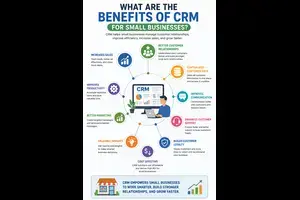
Benefits of CRM for Small Businesses
1. Better Customer Relationship Management
The biggest advantage of CRM is improving customer relationships.
Customers expect:
- Fast responses
- Personalized communication
- Better service
CRM systems help businesses:
- Track customer interactions
- Understand customer preferences
- Store communication history
- Respond quickly to customer needs
When businesses understand customers better, they can build stronger and long-lasting relationships.
Happy customers are more likely to:
- Return for future purchases
- Recommend the business to others
- Trust the brand
Strong customer relationships support long-term business growth.
2. Centralized Customer Data
One of the biggest challenges for small businesses is scattered customer information.
Customer details may exist in:
- Spreadsheets
- Emails
- Mobile contacts
- Paper records
CRM systems store everything in one centralized platform.
Businesses can quickly access:
- Customer names
- Contact details
- Purchase history
- Communication records
- Support requests
This improves organization and reduces confusion.
Centralized data also helps employees work more efficiently.
3. Improved Sales Management
CRM helps small businesses manage sales processes more effectively.
Sales teams can:
- Track leads
- Monitor customer journeys
- Schedule follow-ups
- Manage opportunities
CRM provides a clear overview of:
- Which leads are interested
- Which customers need follow-up
- Which deals are progressing
This helps businesses close more sales and improve conversion rates.
Better sales management leads to increased revenue and growth.
4. Saves Time Through Automation
Manual tasks can consume a lot of time for small businesses.
CRM systems automate many repetitive activities such as:
- Sending emails
- Scheduling reminders
- Updating customer records
- Tracking sales activities
Automation reduces workload and improves productivity.
Employees can spend more time focusing on:
- Customer service
- Business growth
- Strategy planning
Saving time helps small businesses operate more efficiently.
5. Improves Customer Communication
Good communication is essential for business success.
CRM systems help businesses:
- Send personalized messages
- Respond faster to inquiries
- Track communication history
- Manage customer conversations
Businesses can communicate through:
- Phone
- Social media
- Messaging platforms
Better communication improves customer satisfaction and trust.
6. Helps Generate More Leads
Lead generation is important for business growth.
CRM systems help businesses:
- Capture leads
- Organize lead information
- Track lead sources
- Follow up effectively
CRM ensures that businesses do not miss potential customers.
Proper lead management improves:
- Conversion rates
- Sales opportunities
- Business growth
7. Enhances Marketing Strategies
CRM systems help businesses understand customer behavior better.
Businesses can analyze:
- Customer interests
- Purchase history
- Engagement patterns
This helps create:
- Personalized marketing campaigns
- Targeted promotions
- Better email marketing strategies
Targeted marketing improves campaign effectiveness and return on investment.
8. Improves Customer Support
Customer support is extremely important for small businesses.
CRM helps support teams:
- Access customer information quickly
- Track customer issues
- Respond faster
- Provide personalized support
Better support improves:
- Customer satisfaction
- Customer loyalty
- Brand reputation
Satisfied customers often become repeat customers.
9. Increases Productivity
CRM systems improve workflow and reduce manual work.
Employees can:
- Access information quickly
- Collaborate efficiently
- Complete tasks faster
Improved productivity helps businesses:
- Save resources
- Reduce errors
- Increase efficiency
Small businesses can achieve more with limited staff and resources.
10. Provides Valuable Business Insights
CRM systems collect valuable customer and sales data.
Businesses can analyze:
- Sales performance
- Customer behavior
- Marketing results
- Business trends
These insights help businesses make smarter decisions.
Data-driven decisions improve:
- Growth strategies
- Customer experiences
- Profitability
11. Supports Business Growth
As small businesses grow, customer management becomes more complex.
CRM systems help businesses scale by:
- Organizing growing customer data
- Improving communication
- Managing larger customer bases
CRM provides a strong foundation for future expansion.
Businesses can grow without losing control over customer relationships.
12. Helps Build Customer Loyalty
Loyal customers are valuable for long-term success.
CRM systems help businesses:
- Understand customer needs
- Provide personalized experiences
- Maintain regular communication
Customers appreciate businesses that remember their preferences and provide excellent service.
This builds trust and long-term loyalty.
13. Reduces Human Errors
Manual data management often causes:
- Duplicate records
- Missing information
- Communication mistakes
CRM systems reduce errors by:
- Automating updates
- Organizing data properly
- Maintaining accurate records
Accurate information improves overall business performance.
14. Affordable for Small Businesses
Many modern CRM systems are affordable and scalable.
Small businesses can choose CRM solutions based on:
- Budget
- Business size
- Required features
Cloud-based CRM platforms are especially cost-effective.
Businesses can start small and expand CRM usage as they grow.
15. Improves Team Collaboration
CRM systems allow different departments to access shared customer data.
This improves collaboration between:
- Sales teams
- Marketing teams
- Customer support teams
Everyone works with the same updated information.
Improved teamwork helps businesses provide better customer experiences.
Role of AI in Modern CRM Systems
AI-powered CRM systems are becoming increasingly popular.
AI helps businesses:
- Predict customer behavior
- Automate communication
- Analyze data faster
- Recommend actions
AI-powered CRM improves efficiency and decision-making for small businesses.
Industries That Benefit from CRM
CRM systems are useful across many industries, including:
- Retail
- Healthcare
- Real estate
- Education
- Finance
- E-commerce
- Digital marketing
Any business managing customers can benefit from CRM solutions.
Common Challenges Without CRM
Businesses without CRM may face:
- Disorganized customer data
- Missed sales opportunities
- Poor communication
- Inefficient workflows
- Customer dissatisfaction
CRM helps solve these issues effectively.
Future of CRM for Small Businesses
CRM technology will continue evolving with:
- AI-powered automation
- Advanced analytics
- Cloud-based platforms
- Personalized customer experiences
Small businesses using modern CRM systems will gain stronger competitive advantages.
Why Businesses Need Professional CRM Solutions
Choosing and managing CRM systems can be challenging.
Professional CRM services help businesses:
- Select suitable CRM software
- Customize CRM features
- Train employees
- Improve CRM implementation
Expert guidance helps businesses maximize CRM benefits.
Why Choose Cubetechworld for CRM Solutions?
At Cubetechworld, we provide smart CRM solutions designed to help small businesses grow efficiently.
Our CRM services include:
- CRM setup and integration
- Customer data management
- Marketing automation
- Sales tracking
- AI-powered solutions
- Performance analytics
We create customized CRM strategies based on business goals and customer needs.
Our mission is to help businesses strengthen customer relationships and achieve long-term digital growth.
Conclusion
CRM has become an essential tool for small businesses in today’s digital world.
CRM helps businesses:
- Improve customer relationships
- Organize customer data
- Increase sales
- Improve communication
- Save time
- Enhance productivity
- Build customer loyalty
Small businesses that use CRM effectively can compete more successfully and achieve sustainable growth.
As technology continues evolving, CRM systems will become even more important for future business success.
At Cubetechworld, we help small businesses build smarter customer management systems designed for long-term growth and digital success.