Introduction
In today’s digital world, businesses rely heavily on Search Engine Optimization (SEO) to improve online visibility, attract customers, and increase website traffic. SEO helps websites rank higher on search engines like Google, making it easier for people to discover businesses online.
However, many businesses make SEO mistakes that reduce rankings, decrease traffic, and affect overall digital growth. Some companies focus only on keywords, while others ignore technical optimization, user experience, or content quality. Even small SEO mistakes can impact search engine performance significantly.
At Cubetechworld, we believe successful SEO requires proper planning, consistent optimization, and user-focused strategies. Avoiding common SEO mistakes can help businesses improve rankings, generate quality traffic, and achieve long-term online success.
In this blog, we will explore the most common SEO mistakes businesses should avoid, why these mistakes affect website performance, and how businesses can build stronger SEO strategies.
What is SEO?
SEO stands for Search Engine Optimization.
It is the process of improving a website’s visibility on search engines so that users can find the website more easily when searching online.
SEO helps businesses:
- Increase organic traffic
- Improve search rankings
- Build customer trust
- Generate leads and sales
- Improve online visibility
Modern SEO includes:
- Content optimization
- Keyword research
- Technical SEO
- Mobile optimization
- Link building
- User experience improvements
Why Avoiding SEO Mistakes is Important
SEO mistakes can:
- Reduce search engine rankings
- Lower website traffic
- Increase bounce rates
- Create poor user experiences
- Affect business credibility
Search engines now focus on quality, relevance, and user satisfaction. Businesses that ignore SEO best practices may struggle to compete online.
Avoiding mistakes helps businesses:
- Improve visibility
- Build trust
- Increase engagement
- Achieve long-term growth
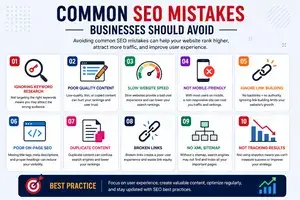
Common SEO Mistakes Businesses Should Avoid
1. Keyword Stuffing
Keyword stuffing happens when businesses use the same keyword repeatedly in content unnaturally.
Example:
“Best SEO company offering SEO services with SEO experts for SEO marketing.”
This creates poor readability and negatively affects user experience.
Search engines now prioritize natural and meaningful content.
How to Avoid It
- Use keywords naturally
- Focus on readability
- Write for users first
- Use related keywords and variations
High-quality content performs better than over-optimized content.
2. Ignoring Search Intent
Many businesses focus only on keywords without understanding what users actually want.
Search intent refers to the reason behind a user’s search.
Example:
A user searching:
“How does SEO work?”
expects educational content, not a sales page.
How to Avoid It
Create content that matches:
- Informational intent
- Transactional intent
- Commercial intent
- Navigational intent
Understanding customer needs improves rankings and engagement.
3. Low-Quality Content
Publishing thin or poorly written content is one of the biggest SEO mistakes.
Low-quality content:
- Provides little value
- Reduces engagement
- Increases bounce rates
Search engines prefer content that is:
- Helpful
- Original
- Informative
- Easy to understand
How to Avoid It
- Create detailed content
- Answer user questions
- Use clear formatting
- Update content regularly
Quality content is essential for long-term SEO success.
4. Duplicate Content
Duplicate content occurs when the same or very similar content appears on multiple pages.
This confuses search engines and affects rankings.
Duplicate content may include:
- Copied blog posts
- Repeated product descriptions
- Similar landing pages
How to Avoid It
- Write unique content
- Use canonical tags when necessary
- Avoid copying from other websites
Original content builds better search visibility.
5. Ignoring Mobile Optimization
Most users now browse websites using smartphones.
A website that does not work properly on mobile devices creates poor user experiences.
Mobile issues include:
- Slow loading speed
- Poor layout
- Difficult navigation
- Small text
Google uses mobile-first indexing, making mobile optimization essential.
How to Avoid It
- Use responsive design
- Improve mobile speed
- Optimize buttons and layouts
- Test websites on multiple devices
6. Slow Website Speed
Website speed is an important SEO ranking factor.
Slow websites frustrate users and increase bounce rates.
Common causes include:
- Large image files
- Poor hosting
- Excessive scripts
- Unoptimized code
How to Avoid It
- Compress images
- Use fast hosting
- Minimize unnecessary plugins
- Enable caching
Fast websites improve user experiences and rankings.
7. Missing Meta Titles and Descriptions
Meta titles and descriptions help search engines understand webpage content.
Without proper meta tags:
- Search visibility decreases
- Click-through rates drop
How to Avoid It
- Create unique titles
- Use keywords naturally
- Write engaging descriptions
- Keep titles concise
Good meta tags improve search performance.
8. Poor Internal Linking
Internal links connect pages within a website.
Many businesses either ignore internal linking or overuse it.
Poor internal linking:
- Reduces crawlability
- Confuses users
- Weakens SEO structure
How to Avoid It
- Link relevant pages naturally
- Use descriptive anchor text
- Improve website navigation
Internal links help users and search engines discover content.
9. Ignoring Technical SEO
Technical SEO affects how search engines crawl and index websites.
Common technical issues:
- Broken links
- Missing XML sitemaps
- Duplicate pages
- Crawl errors
- Poor site structure
How to Avoid It
- Perform regular SEO audits
- Fix technical errors quickly
- Improve website structure
- Use secure HTTPS connections
Technical SEO is essential for search visibility.
10. Buying Low-Quality Backlinks
Backlinks are important for SEO, but poor-quality backlinks can harm rankings.
Spammy backlinks may:
- Reduce trust
- Trigger penalties
- Damage authority
How to Avoid It
- Focus on quality backlinks
- Build natural links
- Create valuable content worth sharing
Strong backlinks improve authority and rankings.
11. Ignoring Local SEO
Many businesses fail to optimize for local searches.
This affects visibility for nearby customers.
Example searches:
- “SEO services near me”
- “Digital marketing company in Hyderabad”
How to Avoid It
- Optimize Google Business Profile
- Use local keywords
- Encourage customer reviews
- Add location information
Local SEO helps businesses attract nearby customers.
12. Not Updating Old Content
Outdated content may lose relevance over time.
Search engines prefer fresh and updated information.
How to Avoid It
- Update blog posts regularly
- Refresh statistics and examples
- Improve outdated pages
Updated content improves rankings and user trust.
13. Ignoring Analytics and SEO Tracking
Without analytics, businesses cannot measure SEO performance effectively.
Important SEO metrics include:
- Organic traffic
- Bounce rate
- Keyword rankings
- Conversion rates
How to Avoid It
Use tools like:
- Google Analytics
- Google Search Console
Tracking helps improve SEO strategies.
14. Poor User Experience (UX)
User experience directly impacts SEO performance.
Poor UX includes:
- Difficult navigation
- Cluttered layouts
- Intrusive pop-ups
- Hard-to-read content
How to Avoid It
- Improve website design
- Simplify navigation
- Use clear layouts
- Focus on readability
Good UX increases engagement and rankings.
15. Expecting Instant SEO Results
SEO is a long-term strategy.
Many businesses expect immediate rankings and traffic growth.
SEO success depends on:
- Competition
- Website quality
- Consistency
- Content strategy
How to Avoid It
- Focus on long-term growth
- Be consistent with optimization
- Monitor progress regularly
Patience and consistency are important for SEO success.
Benefits of Avoiding SEO Mistakes
Businesses that avoid SEO mistakes can:
- Improve rankings
- Increase traffic
- Enhance customer experiences
- Build online trust
- Generate more leads
Strong SEO strategies support sustainable digital growth.
Future of SEO
SEO will continue evolving with:
- AI-powered search
- Voice search optimization
- Mobile-first experiences
- User-focused content
- Advanced analytics
Businesses must adapt to modern SEO trends to remain competitive.
Why Businesses Need Professional SEO Services?
SEO requires technical knowledge, strategy, and continuous updates.
Professional SEO services help businesses:
- Avoid costly mistakes
- Improve rankings
- Increase traffic
- Optimize content
- Track performance effectively
Expert support improves long-term results.
Why Choose Cubetechworld for SEO Services?
At Cubetechworld, we provide advanced SEO solutions designed for modern business growth.
Our SEO services include:
- Keyword research
- Technical SEO
- Content optimization
- Mobile SEO
- Local SEO
- Analytics and reporting
We create customized SEO strategies that help businesses improve visibility, attract customers, and achieve long-term digital success.
Conclusion
SEO is one of the most important tools for online business growth, but common mistakes can reduce its effectiveness.
Businesses should avoid:
- Keyword stuffing
- Low-quality content
- Poor mobile optimization
- Slow websites
- Technical SEO issues
- Bad backlinks
- Ignoring user experience
Modern SEO focuses on quality, user satisfaction, and long-term value.
By avoiding these common SEO mistakes, businesses can improve rankings, increase organic traffic, and build stronger online visibility.
At Cubetechworld, we help businesses create smart SEO strategies designed for sustainable digital growth and future success.

.webp)
.webp)